
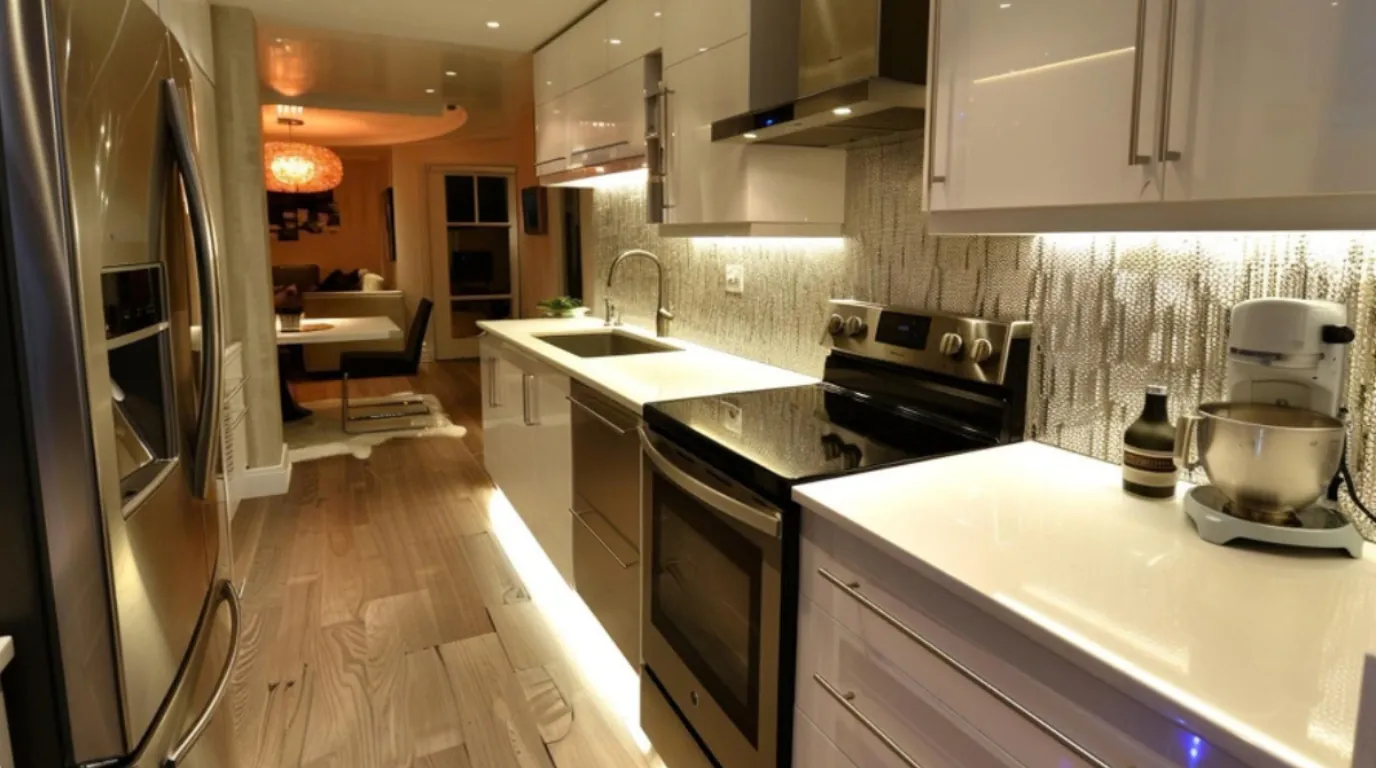
Most kitchen lighting problems in Singapore homes come down to the same mistake: relying on a single ceiling fixture to do a job that actually needs three different layers of light. Kitchen lighting singapore homeowners get right almost always separates task lighting for counters and hobs, ambient light for the room as a whole, and accent lighting for visibility inside cabinets or along toe-kicks — treating a kitchen like a single-light room is why so many HDB and condo kitchens end up with harsh shadows exactly where careful chopping and cooking happen.
The Three-Layer Approach: Task, Ambient, and Accent
Task lighting is the layer that matters most for actual cooking safety and comfort, and it needs to be positioned directly over work surfaces rather than relying on light bouncing off a central ceiling fixture. Under-cabinet LED strips mounted along the underside of upper cabinets are the standard solution here, since they illuminate the counter and chopping area without the cook’s own body or head casting a shadow across the workspace — a common problem when the only light source is a single point overhead.
Ambient lighting fills the rest of the room and is usually handled by ceiling downlights or a central fixture, providing enough general illumination to move around safely and locate items in the kitchen without needing every task light switched on. This layer should be even and shadow-free rather than overly bright, since its job is baseline visibility rather than close-up work.
Accent lighting is the layer most kitchens skip entirely, but it makes a real difference for anyone who cooks regularly — small LED strips inside glass-front cabinets, along open shelving, or under a kickboard add both practical visibility and a more finished look. It’s a relatively inexpensive addition during a renovation but expensive and disruptive to retrofit afterward, which is why it’s worth planning at the same stage as the main lighting layout rather than as an afterthought.
Colour Temperature for Food Preparation Areas
Colour temperature — measured in Kelvin — affects how accurately a kitchen’s lighting renders the actual colour of food, which matters more than most homeowners initially expect. A cooler light in the 4000K to 5000K range is generally recommended directly over prep and cooking areas, since it renders colours more accurately than warmer light, making it easier to judge whether meat is properly cooked or vegetables are fresh. Warmer 3000K lighting works better for any adjoining dining or breakfast-bar area, where the goal shifts from accurate colour rendering to a more relaxed, inviting atmosphere.
Mixing these two temperatures within the same open-concept kitchen-dining space is common and generally works well, provided the transition is intentional — task lighting over the counter in cooler tones, ambient and dining-adjacent lighting in warmer tones — rather than an inconsistent mix caused by replacing bulbs individually over time without a plan.
Common HDB Kitchen Lighting Mistakes
The most frequent mistake is a single central ceiling light with no dedicated task lighting, which forces the cook to work in their own shadow at the counter and stove. A closely related mistake is choosing downlights based purely on wattage rather than actual lumen output — a lower-wattage LED downlight can produce significantly more usable light than an older, higher-wattage design, so wattage alone is a poor way to compare fixtures. Singapore’s Mandatory Energy Labelling Scheme, administered by the National Environment Agency, now requires LED lamps sold locally to meet minimum efficiency standards and display a tick-rating label, which gives homeowners a more reliable efficiency comparison than wattage alone (National Environment Agency, 2018).
A third common mistake is skipping accent lighting inside cabinets during the initial renovation, then discovering afterward how much it would have improved everyday visibility for a relatively small additional cost at the time. Retrofitting cabinet lighting after cabinetry is already installed is considerably more expensive and often requires exposed wiring that a fully planned installation would have avoided.
How Many Downlights Do I Need for My Kitchen?
A rough spacing formula for ambient downlights is one fixture for roughly every 1.2 to 1.5 square metres of ceiling area, adjusted for ceiling height and the downlight’s specific beam angle — a wider beam angle covers more floor area per fixture, meaning fewer downlights are needed for the same coverage. For a typical 6 square metre HDB kitchen, this generally works out to four to six downlights for even ambient coverage, in addition to dedicated under-cabinet task lighting, which is calculated separately based on counter length rather than floor area.
It’s worth noting that any addition or alteration of lighting points and circuits during a kitchen renovation is classified as electrical installation work in Singapore, and must be carried out by a Licensed Electrical Worker rather than a general contractor — this applies equally to adding new downlight points, running LED strip wiring, or installing a new switched circuit for layered lighting (Energy Market Authority, n.d.). Confirming this with a renovation contractor upfront avoids delays later if wiring work needs to be redone by a licensed party before it can be signed off.
Bringing the Three Layers Together
The most reliable approach during a kitchen renovation is to plan all three lighting layers — task, ambient, and accent — at the same time as the electrical rough-in, rather than treating lighting as a finishing touch decided after cabinetry and appliances are already fixed in place. This also makes it easier to coordinate colour temperature consistently across all three layers, since the wiring and switch circuits for each layer can be planned together from the start rather than retrofitted individually.
Frequently Asked Questions
How many downlights does a typical HDB kitchen need?
As a rough guide, one downlight per 1.2 to 1.5 square metres of ceiling area, though this varies with beam angle and ceiling height. A typical 6 square metre kitchen usually needs four to six downlights for ambient lighting alone.
What colour temperature is best for kitchen task lighting?
4000K to 5000K is generally recommended directly over counters and stoves, since it renders food colours more accurately than warmer lighting, making it easier to judge freshness and doneness while cooking.
Do I really need under-cabinet lighting, or is ceiling lighting enough?
Ceiling lighting alone tends to cast shadows across the counter from the cook’s own body. Under-cabinet task lighting removes this shadow and is one of the highest-impact, lowest-cost additions to a kitchen renovation.
Can I add cabinet or under-cabinet lighting after my kitchen is already renovated?
It’s possible but considerably more expensive and disruptive than planning it during the initial renovation, since wiring usually needs to be run after cabinetry is already installed.
Is a higher-wattage downlight always brighter than a lower-wattage one?
No — actual light output is measured in lumens, not watts, and modern LED downlights can produce more usable light at lower wattage than older fixtures. Check the lumen rating and NEA tick rating rather than comparing wattage alone.
Getting kitchen lighting right means planning task, ambient, and accent layers together rather than as an afterthought, and getting the colour temperature and downlight spacing right for how the space is actually used. If your kitchen also needs better airflow, see Best Fans for Small Kitchens & Balconies in Singapore — Corner Fan Buying Guide. Visit the Regal Lighting showroom to see LED downlights, under-cabinet strips, and colour temperature comparisons side by side, with our team on hand to help plan a layout suited to your kitchen’s specific layout.
References
- National Environment Agency. (2018). All Light Bulbs Sold In S’pore To Be Minimally Of LED Efficiency Level From 2023. NEA. https://www.nea.gov.sg/media/news/news/index/all-light-bulbs-sold-in-s-pore-to-be-minimally-of-led-efficiency-level-from-2023
- Energy Market Authority. (2026). Who Should I Engage To Assist With My Electrical Works? EMA. https://ema.gov.sg/resources/faqs/electricity/general-electricity-works/who-should-i-engage-to-assist-with-my-electrical-works-eg-rewiring-of-my-house