
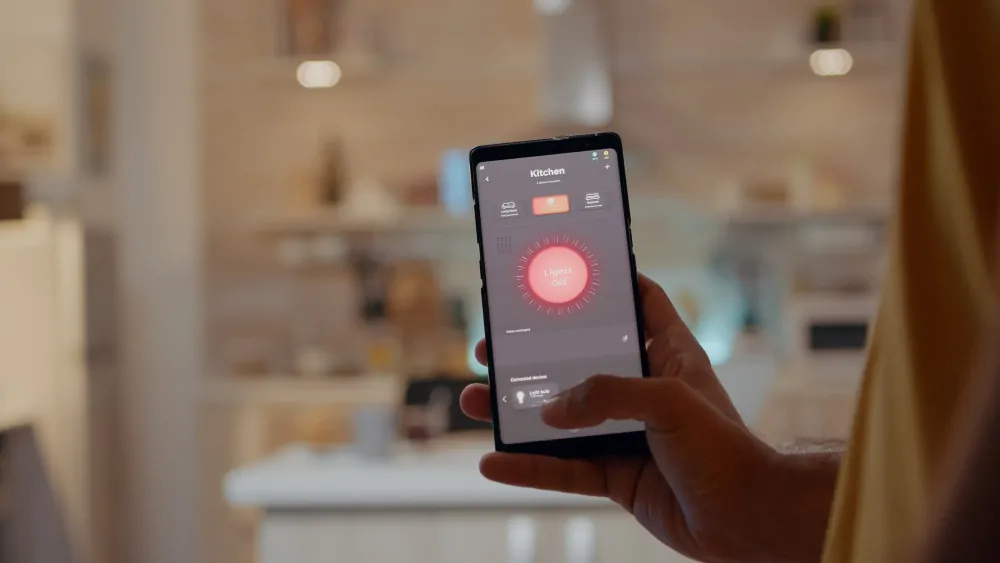
You are halfway to Changi Airport when it hits you: did you leave the living room lights on? A few years ago, the answer involved either turning back or a nagging feeling for the entire trip. Today, it takes three seconds and a phone screen.
Smart switches are the fastest-growing upgrade in Singapore smart homes — and for good reason. Unlike smart bulbs, a smart switch works with your existing lights, keeps your physical switch functional, and gives you app control, voice commands, and automated scheduling from a single wall plate. In this guide, we cover everything you need to know: how they work, why they beat smart bulbs for whole-room control, how to install one in an HDB or condo, and how to build them into a complete smart home lighting system.
1. What Is a Smart Switch?
A smart switch is a WiFi or Zigbee-enabled wall switch that replaces your existing light switch. Once connected to your home Wi-Fi network (typically 2.4GHz), it allows you to:
- Turn lights on and off remotely via a smartphone app — from anywhere in the world.
- Set schedules so lights turn on and off automatically at preset times.
- Control lights with your voice using Amazon Alexa, Google Home, or Apple Siri.
- Create scenes — one tap turns off every light in the house at bedtime.
- Monitor energy usage in real time (on supported models).
Crucially, the physical switch still works exactly as before. You — and everyone else in the household — can still tap it manually. Smart functionality is layered on top, not in place of, the switch you already know.
2. Smart Switch vs Smart Bulb: Which Is Better for Singapore Homes?
This is the most common question homeowners ask when entering the smart lighting space. Here is the honest comparison:
| Feature | Smart Switch | Smart Bulb |
|---|---|---|
| Works With Any Bulb | Yes — controls any existing bulb | No — must replace every bulb |
| Physical Switch Still Works | Yes — switch functions normally | No — turning off kills smart functions |
| Cost Per Room | S$40–S$120 per switch | S$25–S$60 per bulb (× number of bulbs) |
| No. of Devices to Replace | One switch per circuit | Every bulb in the circuit |
| Works in Power Cut | Manual switch still works | No smart function without power |
| Voice / App Control | Yes — Alexa, Google Home, Siri | Yes — with compatible hub/app |
| Scheduling | Yes — via app | Yes — via app |
| Dimming | Yes (with compatible dimmer switch) | Yes (with dimmable smart bulb) |
| Aesthetics | Same as standard switch — clean look | Visible bulb difference in some fixtures |
| Installation Complexity | Requires licensed electrician (Singapore) | DIY — screw in and connect to app |
The Verdict
For whole-room lighting — which describes most Singapore HDB and condo fixtures — smart switches are the superior solution. A living room ceiling light with a single switch controls the entire circuit. Replacing that one switch gives you full smart control instantly, at a fraction of the cost of replacing every bulb in the fitting.
Smart bulbs make sense for table lamps, reading lights, or decorative fixtures where colour-changing or ultra-fine dimming is the goal. For the main lights in every room — the ones you actually control with a wall switch — a smart switch is more practical, more cost-effective, and easier to live with day to day.
3. Remote Control: Run Your Lights from Anywhere
Control every light in your home from a single smartphone app — whether you are in the next room or overseas.
The most immediately useful feature of a WiFi light switch in Singapore is simple: you never have to wonder if you left a light on again.
Through the switch’s companion app (typically available for both iOS and Android), you can:
- See the live on/off status of every connected switch in real time.
- Toggle any light individually, or turn everything off at once with a single tap.
- Group switches by room — tap ‘Bedroom’ to control all bedroom lights together.
- Share access with family members, so everyone in the household can control lights from their own phone.
For Singapore households where both partners work long hours, or for elderly family members who may forget to switch off lights, remote control is not a gimmick — it is a practical daily utility.
4. Scheduling: Let Your Lights Run Themselves
Scheduling is where a smart switch transitions from a convenience upgrade to a genuinely intelligent home system. Instead of remembering to turn lights on or off, you set the rules once and let the switch handle it forever.
Here are practical scheduling scenarios that Singapore homeowners are using right now:
| Scenario | Schedule | Benefit |
|---|---|---|
| Away on holiday | Living room lights on 7–10 PM daily | Occupied appearance deters opportunistic crime |
| Morning routine | Kitchen light on at 6:30 AM on weekdays | No fumbling for switches half-asleep |
| Bedtime | All lights off at 11 PM | Never leave lights on accidentally overnight |
| After-school return | Hallway light on at 2:30 PM | Children arrive to a lit home safely |
| Overnight security | Porch light on 12 AM–6 AM | Deters late-night loitering |
| Energy saving | All switches off if no motion for 30 min | Reduces electricity bill automatically |
Scheduling also has a meaningful impact on electricity bills. SP Group data shows that lighting accounts for approximately 15–20% of household electricity consumption in Singapore. Lights that switch themselves off when no one is home — or after bedtime — eliminate waste without requiring any behavioural change from the household.
5. Voice Control: Alexa, Google Home & Siri
Every major smart switch sold in Singapore today supports at least one of the three leading voice assistant ecosystems:
- Amazon Alexa — “Alexa, turn off the living room lights.”
- Google Home — “Hey Google, dim the bedroom to 50%.”
- Apple HomeKit / Siri — “Hey Siri, goodnight.” (triggers a scene that turns off all lights)
Voice control is particularly useful in the kitchen (hands full of groceries), the bedroom (lights off without getting up), and for elderly family members who find apps less intuitive than simply speaking a command.
Building a Complete Smart Home Lighting Ecosystem
A smart switch is the ideal foundation for a broader smart home — and it integrates naturally with the full range of lighting options at Regal Lighting, from downlights and track lights to pendant lights and LED strips. Once your switches are smart, you can layer in:
- Smart ceiling fans (Regal Lighting carries Wi-Fi fans from Point One, Fanco, and Crestar) that respond to the same app and voice commands.
- Motion sensors that trigger smart switches to turn lights on automatically as you enter a room.
- Smart scenes that combine lights, fans, and other devices into a single command — “Movie Time” dims the living room lights to 20% and closes the blinds simultaneously.
- Geofencing that detects when your phone (and therefore you) approaches home and turns on the porch and hallway lights automatically.
6. Installation: How to Replace a Standard Switch with a Smart Switch in Singapore
This section covers what is involved in a smart switch installation in Singapore. We strongly recommend engaging a licensed electrician for the actual wiring work — it is a legal requirement under EMA regulations and takes under 30 minutes per switch for a professional.
What You Need
- A compatible smart switch (check: 1-gang or 2-gang to match your existing switch plate)
- A neutral wire in your switch box (most Singapore HDB and condo wiring post-1990 has this — your electrician can confirm)
- A stable 2.4GHz Wi-Fi signal near the switch location
- The switch’s companion app downloaded on your smartphone
Step-by-Step Process
- Turn off the circuit breaker for the relevant circuit at your DB box.
- Your licensed electrician removes the existing switch plate and disconnects the wiring.
- The smart switch is wired in — Live, Neutral, and Load terminals — and the plate is fitted.
- Power is restored. The switch LED indicator confirms it is powered on.
- Open the companion app, select ‘Add Device’, and follow the pairing instructions — typically under 3 minutes.
- Name the switch (e.g., ‘Living Room Main’), assign it to a room, and connect to Alexa or Google Home if desired.
- Test: toggle the switch via app, set a test schedule, and try a voice command.
Total time from start to fully operational smart switch: approximately 45–60 minutes including app setup. An electrician typically charges S$50–S$100 per switch for the installation work in Singapore.
Important Note for HDB Owners
HDB permits the replacement of light switches as a standard maintenance item — no renovation permit is required. The work must be carried out by a licensed electrician registered with the Energy Market Authority (EMA). Do not attempt to replace switches yourself; incorrect wiring is a fire hazard and voids your home insurance.
7. Real-Life Scenario: The Airport Moment That Triggered a Smart Home Upgrade
“I was at the departure gate at Changi Terminal 3, boarding a flight to Tokyo, when I suddenly could not remember if I had turned off the study light,” recalls Wei Lin, a 42-year-old finance professional living in a 5-room HDB in Bedok. “I could not turn back. I spent the entire eight-hour flight mildly anxious about it.”
“The day I got back, I messaged Regal Lighting and asked about smart switches. Within two weeks, every main light in my flat was on a WiFi switch. Now I check the app before boarding and I can see every switch is off. I can even turn them on from Tokyo if I want to. That anxiety is completely gone.”
Wei Lin’s experience is one of the most common entry points into smart home lighting in Singapore — a single moment of uncertainty that makes the value of remote control immediately and personally obvious.
8. Ready to Make the Switch?
Here is a simple checklist to determine if a smart switch upgrade is right for your Singapore home:
- Do you ever wonder if you left a light on after leaving home?
- Do you want to automate your home’s lighting without replacing every bulb?
- Are you building or expanding a smart home with Alexa or Google Home?
- Do you have elderly family members who would benefit from voice-controlled lights?
- Are you looking to reduce your electricity bill through smarter light scheduling?
If you answered yes to any of these, smart switches are your next home upgrade. Visit Regal Lighting’s showroom at Sin Ming Road or Chai Chee — our team can recommend the right switch for your wiring setup and walk you through compatibility with your existing lights. Download our Lighting Catalogue for a full overview of smart-compatible lighting options currently available.
Frequently Asked Questions (FAQs)
Q1. Do smart switches work with any light fitting in Singapore?
Yes — a smart switch controls power to the circuit, not the bulb itself. This means it works with any light fitting connected to that circuit: LED downlights, ceiling lights, pendant lights, spotlights, and fluorescent tubes. The only exception is fixtures with their own separate smart control system. For dimming functionality, you will need both a compatible dimmer smart switch and dimmable LED bulbs in the fitting.
Q2. Do I need a hub or smart home controller for a WiFi smart switch?
Most WiFi smart switches sold in Singapore connect directly to your home’s 2.4GHz Wi-Fi router — no separate hub is required. Simply download the brand’s app, connect the switch to your Wi-Fi, and you are live. For voice control, you link the app to your Alexa or Google Home account, which also requires no additional hardware. Zigbee-based switches do require a compatible hub, but WiFi models are the standard for Singapore residential use.
Q3. Where can I find out which smart switches are compatible with my HDB wiring?
The most reliable way is to have a licensed electrician check your switch box before purchasing — they can confirm whether a neutral wire is present and what gang size your existing switches are. You can also contact the Regal Lighting team directly via the Regal Lighting contact page or call +65 6458 0313 or +65 6241 2029 for guidance on compatible options for your specific setup.
Q4. Can I still use the physical switch after installing a smart switch?
Yes — this is one of the key advantages of a smart switch over a smart bulb. The physical switch on the wall continues to work exactly as before, for every member of the household. Smart functionality (app, voice, scheduling) is an additional layer of control, not a replacement for the manual switch. Guests and family members who are not familiar with the app can still use the switch as normal.
Q5. Is a smart switch more expensive than a traditional light switch in Singapore?
Smart switches typically range from S$40 to S$120 per unit in Singapore, compared to S$5–S$30 for a standard switch. However, when you factor in the whole-room coverage (one switch controls an entire circuit of lights), the cost per controlled light is often lower than equipping each fitting with an individual smart bulb. Add in electricity savings from scheduling and the convenience value of remote control, and most Singapore homeowners find the upgrade pays for itself within one to two years.
References & External Sources
The following authoritative sources were referenced in this article:
-
- Energy Market Authority (EMA) Singapore — Licensed Electrical Worker — EMA regulations on electrical switch installation in Singapore.
- SP Group Singapore — Household Electricity Consumption — Data on residential lighting electricity usage in Singapore.
- Housing & Development Board (HDB) — Renovation Guidelines — HDB rules on permitted electrical works in flats.
- Smart Nation Singapore — Smart Home Initiatives — Singapore government’s connected home and smart living programmes.
- Amazon Alexa Compatible Devices — Reference for Alexa-compatible smart switch certification.