
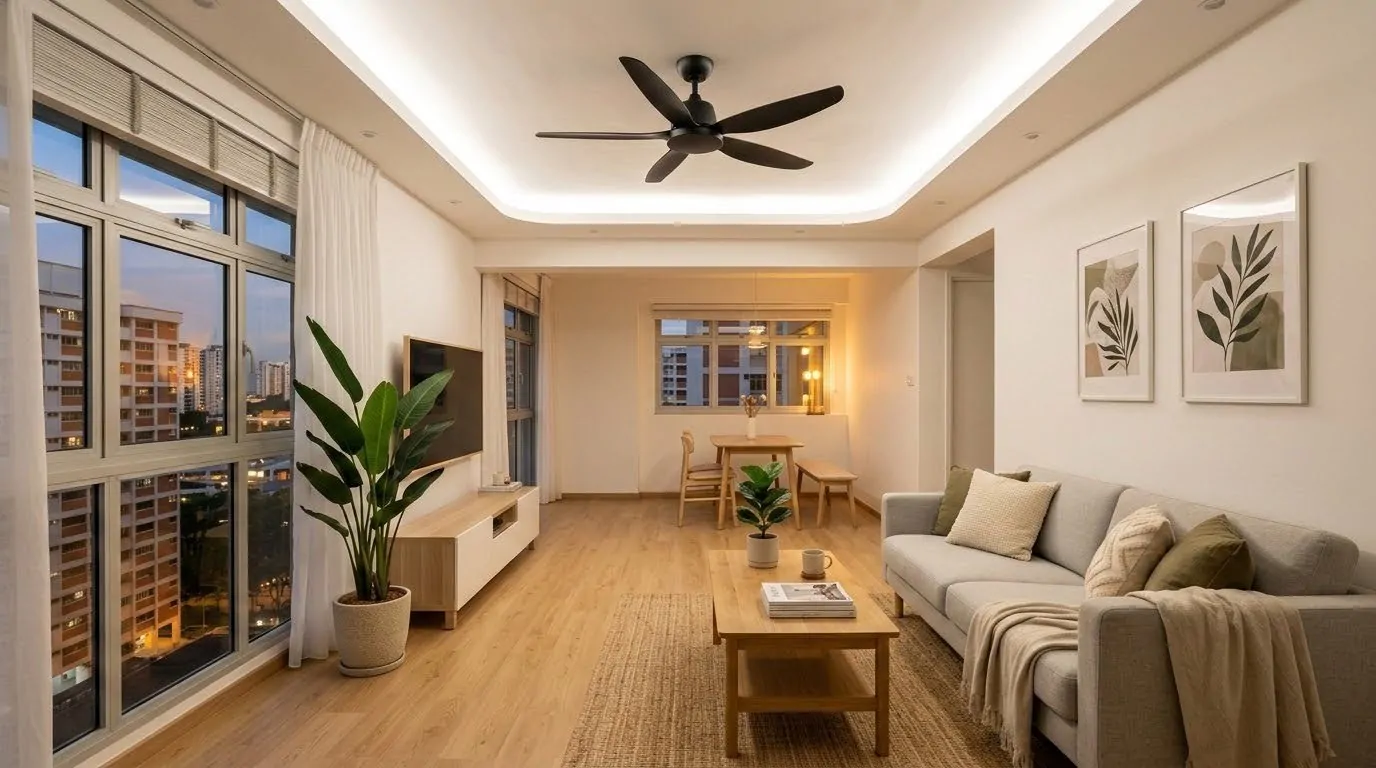
Singapore’s climate makes a ceiling fan one of the most practical investments you can make in your home. Running a ceiling fan on a moderate speed costs a fraction of running an air-conditioner, and in the evenings or on days when the temperature drops, a ceiling fan alone is often enough to keep a bedroom or living room comfortable without turning the aircon on at all. But with dozens of models, blade sizes, motor types, and brands available across Singapore lighting stores, choosing the right ceiling fan for your specific rooms can feel overwhelming.
This guide simplifies the process. We cover blade span by room size, DC vs AC motor differences, noise levels, energy consumption, mounting options for low HDB ceilings, and a brand-by-brand comparison of the most popular models at Regal Lighting Gallery — so you can make a confident, well-informed decision before you buy.
Step 1: Choose the Right Blade Span for Your Room Size
Blade span — the diameter of the circle the fan blades sweep — is the most fundamental specification. An undersized fan in a large room will circulate air weakly. An oversized fan in a small room creates uncomfortable draughts and looks disproportionate.
- Small bedroom / study (up to 10 sqm): 36–42 inch blade span
- Standard HDB bedroom (10–15 sqm): 42–48 inch blade span
- Master bedroom (15–20 sqm): 48–52 inch blade span
- Living room HDB (20–30 sqm): 52–56 inch blade span
- Living room condo/landed (30 sqm+): 56–60+ inch blade span
- Kitchen / service area (up to 8 sqm): 36–40 inch blade span
If you are between sizes, choose the larger blade span. A fan that is slightly too large will always perform better than one that is too small.
Step 2: DC Motor vs AC Motor — Which Should You Choose?
AC Motor Ceiling Fans
AC motors are the traditional standard and remain popular in Singapore due to their lower upfront cost and proven reliability. They are robust, straightforward to repair, and widely available. The trade-off is higher energy consumption — typically 50 to 80 watts — and slightly more audible operation at higher speeds. For secondary bedrooms, kitchens, and utility areas where the fan runs intermittently, an AC motor fan is a practical, cost-effective choice.
DC Motor Ceiling Fans
DC motor fans use up to 70% less electricity than equivalent AC models — typically running at 15 to 35 watts — and operate significantly more quietly. They also offer more speed settings (often 6 to 9 steps vs 3 on most AC fans), giving you finer airflow control. DC motors are the recommended choice for bedrooms where noise is a concern, living rooms where the fan runs for long periods, and any space where energy efficiency is a priority. The higher purchase price is typically recovered through electricity savings within two to three years of daily use.
Hugger vs Standard Mount: A Critical Decision for HDB Flats
Many Singapore HDB flats have ceiling heights of 2.6m to 2.7m — close to the minimum safe clearance of 2.1m between the floor and the lowest point of the spinning blades. Standard ceiling fans hang on a down rod, which reduces that clearance further. In low-ceiling rooms, a hugger mount — also called a flush mount — is essential.
Hugger ceiling fans attach directly to the ceiling box without a down rod. Models designed specifically for this include the Fanco Co-Hugger series and select Point One ceiling fans with low-profile motor housings. If your room has a ceiling height of 2.8m or above, a standard mount with a short down rod is fine.
Ceiling Fans With Lights: What to Know Before Buying
Ceiling fans with integrated LED light kits are a practical space-saving solution for Singapore bedrooms and living rooms. When evaluating integrated light kits, look for lumen output of at least 1,500 to 2,000 lumens for adequate room illumination, a colour temperature of 3000K for bedrooms and living rooms, and dimmability via remote where possible.
Brand Comparison: Fanco, Point One, Alaska, and Efenz
Fanco Ceiling Fan
Fanco is one of Singapore’s most established ceiling fan brands, known for a wide range of models from budget-friendly to design-forward. Fanco ceiling fans include the Co-Hugger (DC motor, ideal for low ceilings), the B-Star (DC motor bestselling model with LED light kit), and the Rito (stylish DC motor model for modern interiors).
Point One (PO Eco) Ceiling Fan
Point One fans use Japanese ball bearings and EC (electronically commutated) motors — one of the quietest and most energy-efficient motor technologies available. If near-silent operation is your priority, Point One is consistently the top recommendation. Models are available in standard and hugger configurations.
Alaska Ceiling Fan
Alaska targets the premium segment and is a strong choice for master bedrooms and large living rooms in condominiums and landed properties. Alaska’s models are widely regarded as among the quietest large-blade fans available in Singapore.
Efenz Ceiling Fan
Efenz occupies the design-forward premium segment, with sculptural blade profiles and high-quality finishes that make the fan itself a design feature. Best suited for homeowners who want the fan to contribute to the room’s aesthetic as much as its airflow.
Frequently Asked Questions
Q: How do I know if my ceiling can support a ceiling fan?
A: All Singapore HDB flats have a designated ceiling fan point that is structurally reinforced to support a fan. If there is no existing fan point, your electrician or contractor will need to install a proper mounting bracket before the fan can be fitted.
Q: Can I install a ceiling fan myself?
A: Singapore regulations require ceiling fan installation to be carried out by a licensed electrician. Professional installation also ensures your warranty remains valid.
Q: How often should I clean my ceiling fan?
A: In Singapore’s dusty HDB environment, cleaning fan blades once a month is recommended. Unbalanced dust accumulation is a common cause of wobbling and noise.
Q: What remote control options are available?
A: Most DC motor ceiling fans include a handheld remote as standard. Some premium models support WiFi control via a smartphone app or compatibility with Google Home and Amazon Alexa.
Q: Is a more expensive ceiling fan worth it?
A: For primary bedrooms and living rooms used daily, yes. The energy savings from a DC motor fan and the noise benefit of a quality motor significantly improve daily comfort. For utility areas and secondary rooms, a well-made AC motor fan is sufficient.
Conclusion
Choosing the right ceiling fan Singapore for each room comes down to four key decisions: blade span matched to room size, DC or AC motor based on usage frequency and budget, hugger or standard mount based on ceiling height, and whether an integrated light kit is needed. Regal Lighting Gallery stocks all the brands covered in this guide — with running display models so you can hear the noise level and feel the airflow before you buy. Visit our showroom or contact our team for personalised recommendations. We are open seven days a week.
References
- Housing & Development Board Singapore — HDB Flat Specifications and Ceiling Heights — https://www.hdb.gov.sg
- Energy Market Authority Singapore — Household Appliance Energy Labels — https://www.ema.gov.sg
- Singapore Standards Council — SS 473 Ceiling Fan Safety Standards — https://www.enterprise.gov.sg/standards